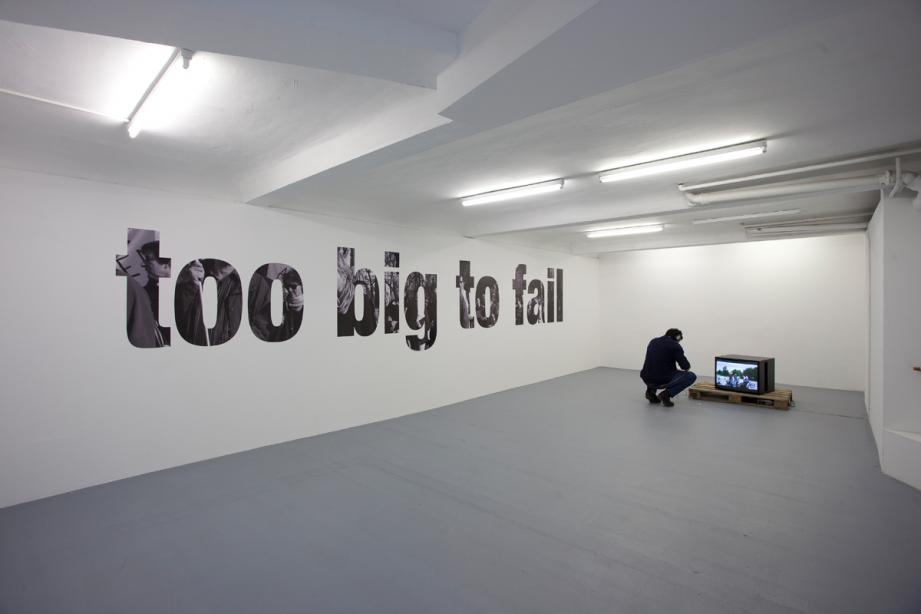
artist talk Shin Il Kim and Felix Ruhöfer
See show here.
Further information about the presented artworks of Shin il Kim will be found in the text!
FR (Felix Ruhöfer)
Shin il, you mentioned a strong connection between eastern philosophical and western, art historical formal ideas in your work. Could you describe the interest and the impuls to work with these two different sources?
SK (Shin il Kim)
When I look at the art history from Modernism to Conceptual art, art history has been reformed with various ways of looking at objects and idea of defining art itself. In order to suggest a something different in any field, it is better to mention different sources from what we had before.
Zen Buddhism already has reached the West since 1930s in England and 1950s in America and influenced to Fluxus member. But I think that there should be different way of using this Buddhism idea into artworks and I believe that my understanding about Seon (Zen in Japanese) Buddhism can suggest a different way of thinking and making artworks.
I try to mingle my understanding about Greenberg’s theory in terms of ‘importance of materiality’ and the idea of Buddhism.
FR
With these information in mind, could you describe the process of creating the ‚line drawing animations’ which form the center of your show here at ‚basis’?
SK
‘Void’ is the main key to practice Seon Buddhism. As Greenberg’s idea, it is important to consider materiality itself in artwork.
One of the ways to depict these two ideas into artwork is to draw objects using no color but a single pressed line on paper, a minimal gesture on a white page, so that the drawing can be seen or not according to the angle of light. The pressed line on paper embraces visual emergence and disappearance simultaneously with the angle of light. After making hundreds of these drawings, they are animated at 30 drawings per second. I start with an image that is then traced frame by frame. I go from video to drawing back to video. In this process, I endeavor to combine the main aspects of each of the 2nd, 3rd, 4th, and 5th dimensions, as in painting, sculpture, video, and light to see other possible forms in the art.
FR
Is drawing in any sense more important as a starting point for your work which is, if we just focus on the final work, video based?
SK
They are both important. My drawing is conceptual drawing concerning ‘Void’ since there are no other physical materials but only my action of pressing a line onto paper. But there is still paper, which is material, so I use video, which has no touchable materials because of its source of light, to bring my drawing to get closer to the idea ‘void’. Therefore, this twofold helps each other.
FR
What was of importance for me after seeing your work for the fist time was the transformation from drawing into something different, a new medium, video or film. But never the less, I was impressed by the presence the drawings remained in the animated videos. For me, your work is in a way based on drawing as a conceptual starting point. The film, the outcome of the whole process, still bears this ‚drawing quality’ for me. I guess this quality is based in the dynamic the shadows of pressed lines on the paper create, a phenomenon which is deeply connected to the specific qualities of the medium drawing. How important is the medium ‚drawing’ and the transformation from one medium to another for you?
SK
Drawing is a means of reproducing concept directly from thinking since it has least interruption, because of its simplicity, during the process of making it. This simplicity is a proper way to visualize the idea of void for me.
Video’s strong aspects are light and time, which are not physically touchable. I take these immaterialities to cover drawing’s materiality to convey my idea of void.
When I use different media I can take the merit of these media to make other possible forms in art. The main aspect of time and light in video is important for me to develop my drawing into something void.
FR
Are there any artists/ pleople you worked with or a special philosophical thinker who are of important for your work and your thinking?
SK
Jong Tae Choi, my professor from my university in Seoul, Buddhism and Taoism. Michel Foucault, Clement Greenberg, Arthur Danto, etc.
FR
You also mentioned Clement Greenberg. Is his definition of art as a self reflection of the medium important for your art, especially for the line drawing animation?
SK
Yes, since I use medium there is always in a way self-reflection of the medium. His main idea is to analyze and categorize art itself and this analysis ends up to importance of medium. I am more interested in his point of analyzing than categorizing art itself. Also in Buddhism, analyzing entities is the main key to find ‘void’. I have ended up to my pressed line drawing through analyzing my idea and medium.
FR
The notion ‚nothingness’ which you use in the eastern, philosophical idea, brings an existentialism into play that seems to be far away from the formal questioning of art in Greenbergs idea. Could you describe how these different starting points intermingle in your work?
SK
A different thing between this twofold is that Greenberg ended up to ultimate physical materiality whereas Buddhism ends up to mental enlightenment through analyzing something itself (among other ways to do Buddhist practice). However the limitation of his idea was already found by uprising pop art and conceptual art. So, I try to overcome Greenberg’s limitation of medium through Buddhism idea concerning ‘void’.
FR
Someone described your work as a reflection on the connections between the artwork, the artist (which also means the intention of the artwork) and the audience. This threefold connection seems to be a highly complex system. It seems to me that your art is also a commentary or a questioning of the social function of art today.
How could this function of art be formulated through the formal and philosophical ideas you bring into play?
SK
For me, the function of art is ‘communication’ through art with others. So, I have been thinking how this communication be formed. There are necessary parts for this communication, which are the artwork, the artist and the audience as medium, and they help each other to complete art. In order to communicate with others there should be appreciation also. In some of my works, I use this threefold as media to mention the important moment appreciating artwork.
I also tried to find relationship between this threefold as medium to convey my idea of void. I show a possible way to visualize ‘void’ through the relationship between these three.
FR
To quote a sentence you wrote: „My ultimate goal for art is to get closer to the idea of nothingness but also to show something with nothingness.“
It seems to be clear how you can show something with nothing in a phenomenological way, if we keep in mind the pressed line drawings which are visible only through the shadows the pressed lines display on the paper. But why is it interesting for you to get closer to the philosophical idea of nothingness which seems to deny the idea to create ‚something’ new, to overcome the nothingness of the empty space, the white paper or the white canvas? Nothingness is a critical notion in eastern philosophy, but it seems to be far away from artistic traditions in the West to create something, something new, if possible, since the late Middle Ages. Could you describe the importance of nothingness, the way it is used in the Eastern and in the Western tradition for your work?
SK
I can somehow see a kind of nothingness through Duchamp’s ‘Fountain’ because there is no artist made object but only the idea, which is also physically nothing. And conceptual art was influenced by this idea. I think that he also thought about the importance of viewers that complete the meaning of artwork. His idea is important but has also limitation of self-denial. In Buddhism there is no truth without oneself.
In Arthur Danto’s book, ‘After the end of art’, about pop art, it seems that there is no more new creation in art history because pop art has reached to the end. If there is no more creation then I restart from ‘nothing’. The idea of nothingness is one of ideas for other possible creation in art. I don’t try to make something just nothing but observe their relationship and the condition between things. It is all depends on how we interpret the meaning of ‘nothingness’, but my understanding of nothingness is not merely nothing but meaning of interdependent entity. Finding relationship and condition between things are the way to realize what the interdependent entity is.
I once wrote that ‘There is no more creative idea than the idea of nothingness’
FR
The nothingness in your work seems to be an absence of something, a physically present line, for example in the line drawing animations. Is there a difference between the notion ‚nothingness’ and ‚absence’ in your understanding? And how would you describe the way you use these two notions in your art?
SK
I think that nothingness is broader notion than the notion of absence. Absence of something is part of many other way of visualizing nothingness in art. I also sometimes use ‘absence’ to convey my concept. I visualize something ‘absence’ through other thing, which is related to the absent one, by emphasizing the relationship between these two.
FR
For the western observer of your works, it could be confusing to think about the use of the idea of ‚absence’ and the object status of works of art. I think it is interesting to hear more about your definition of the notions ‚nothingness’, and ‚absence’, to make clear the philosophical dimension the way the notion is used in the Eastern tradition and in your works.
One of the first western movements which questioned the object status of the artwork, conceptual art in the late 60s and early 70s, did that in regard of the power of the art market which seemed to corrupt artistic practice and in regard of the conviction that artistic practice is not essentially a physical object but an idea, a mental process. Is there a connection to your thinking of ‚nothingness’? I guess the western idea of the absence of an artwork is highly charged with the conceptual idea of the object status of the work of art. Or is your thinking of ‚nothingness’ deeply connected to the formal, more phenomenological idea of the word which lead to the philosophical traces of the notion?
SK
As I partly mentioned above, nothingness’, and ‚absence’ is not merely nothingness but the way of describing the fact of interdependent entity. Everything changes depends on its relationship to others, so if we really try to find the ones own meaning, there is nothing. What is left is ‘Relationship’ between things.
Conceptual art, as I partly mentioned on the question number 1 and 10, was influenced by Buddhist mentalism, which means the definition of truth is depends on one’s mind. If we change our mind things are also changed. So, if we consider concept in conceptual art as one’s mind, the change of concept changes the medium, as well. I can interpret nothingness this way for conceptual art but this is only a part of other condition in nothingness.
I would say that my idea of nothingness is phenomenological idea.
FR
In how far are the notions ‚existence’ and ‚non-existence’ important for your artistic practice? Is it your aim to define a connection between eastern and western ideas to rethink the meaning of an artwork and its role in society today?
SK
It is better to consider both side, ‘existence’ and ‚’non-existence’, than a single side to search more possible creation in art.
The Nothingness which I intend to quest is neither the complete emptiness nor the pure opposition to being. It is a neutral value, which can include being and Emptiness altogether, and remedy the antagonism between the emptiness and being. I am given to understand that this is the middle path.
As I mentioned above ‘Nothingness’ is a relationship and the mid path between ‘existence’ and ’non-existence’, synthesis of this twofold.
I think that Greenburg’s focus was more on ‘existence’, medium, so that he narrowed down artistic creativities. And original conceptual art’s focus was more on ’non-existence’ part, idea, so that it narrowed down of viewer’s access to appreciate artwork.
I try to overcome these two barriers through my understanding of ‘void’.
FR
You mentioned the idea that existence and non-existence are not two oppositional entities, but create a connection. This is indeed an eastern idea which is difficult to understand for western thinkers. It is interesting to see how you connect the eastern and western ideas about existence or the notion ‚void’, because the notion has its own special quality. To define nothing or a void as a neutral circumstance is interesting, too. I think we should talk about the works on display here in the show to discuss your concepts in detail.
‚Invisible Masterpiece’
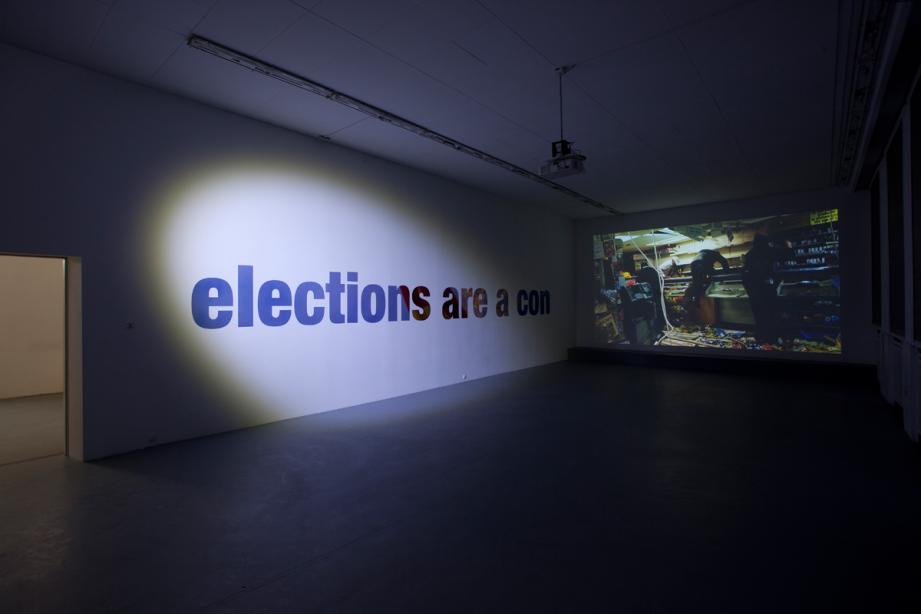
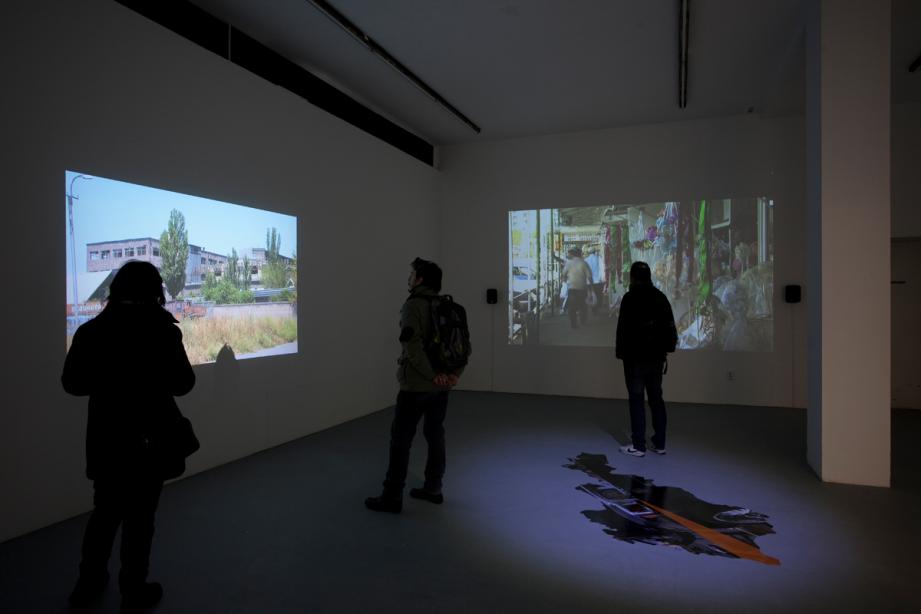
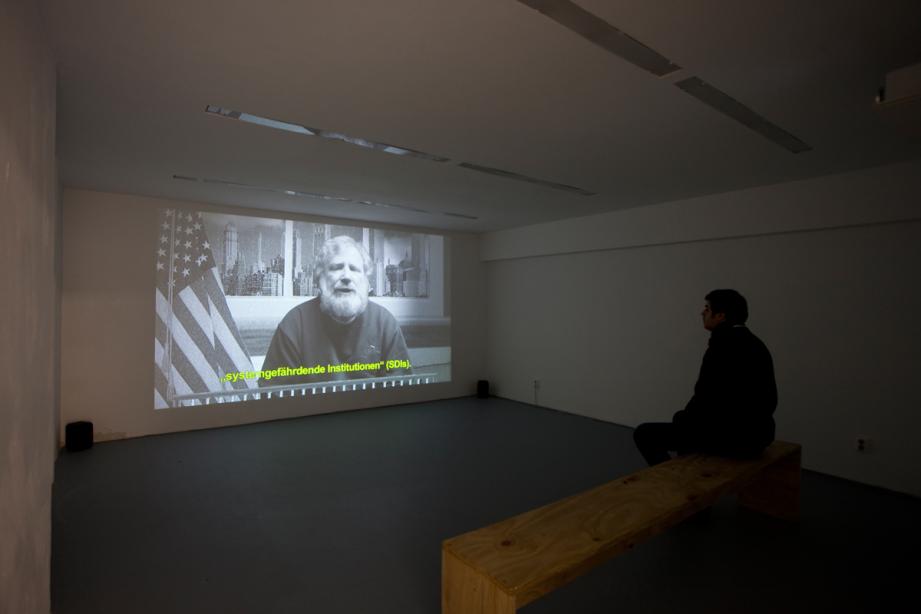
The biggest installation which is built out of three projections is ‚Invisible Masterpiece’. Here, your concept of connecting three aspects which are mostly distanced in art, becomes clear, I guess. The work shows the materiality of the medium drawing, it also reflects the buddhist idea of the void and its connection to the medium video and it also shows your interest in the social function of art. The people who move in front of not visible artworks at the Metropolitan seem to create a kind of a dance, a disciplined movement around something sacred. The work focuses on the way we react on artworks which seem to be more than pure materiality, more like a sacred object. The title ‚Invisble Masterpiece’ relates to Hans Belting’s book from 1998 with the same title. Belting discusses the role of the art object and the changes in the understanding of artworks in the last 200 years. This role is influenced by the idea of something like a masterpiece which distances the art object from the rest of the object world. The art object becomes something sacred, art seems to fill the gap religion lost it dominant role in modern society. Not a religious practice, but the artwork seems to bet he opposite to our rational object world. The invisible masterpiece, in Belting’s point of view, is the utopian idea of the coming of the perfect artwork, the unchangeable and the absolute art, the idea of an impossible creation which equals art and the spiritual experience.
In your work, this special role of the work of art Belting describes becomes obvious, I guess, because people seem to meditate in front of the work of art, they accept a special role of the artwork. On the other hand, it’s not quite clear if someone really reflects the construction of this status which is forced due to the role of the museum since 1800. For me, all these aspects are a part of your work. And furthermore, it seems to be witty to name it ‚invisible masterpiece’ because the works (masterworks) are not visible in your installation. You fool around with the notion of the void and invisibility without loosing a deeply based conceptual idea.
How would you describe the most important aspects of this work? What was the starting point for the piece, on the background of your conceptual idea?
SK
When viewers see this work they would question where the masterpieces are, because of its title Invisible Masterpiece or even they don’t see the title they would think that the viewers in this work are watching artworks because of the museumgoer’s sacred action of watching artworks. Therefore, the real viewers, watching this work, see the emptiness of artworks. I was trying to depict void of artworks especially with so-called masterpiece, which I thought a symbol of power that sometimes blinds other possible creativities in art and leads us to passive reaction to what is happening in our daily life. There are three layers to complete this works-the viewers in my works, real viewer watching this work and the invisible masterpieces. Since the viewers in this work are visualized by only an angle of light, no other material, because of its colorless drawings on paper, everything becomes void again. Finally, the actual viewers become aware of their reaction to this work.
FR
‘Water’
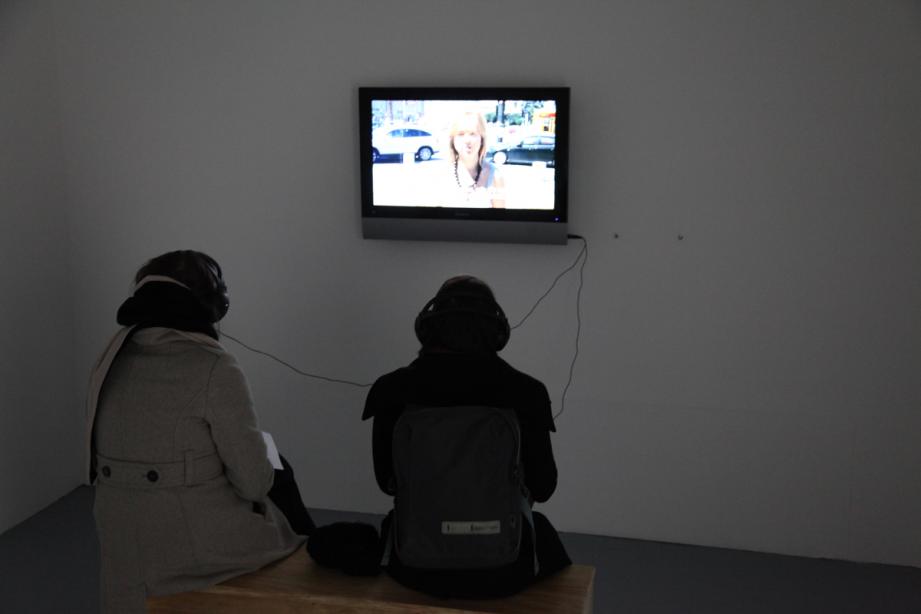
Also on display here at basis is the work ‚Water’, again, one of your ‚line drawing animations’. Here, you took the topic void, nothingness and the ‚nothing’ in a materialistic sense of the word, the shadow which resembles a line, (but it is a material nothing) a bit further, or in a new direction. The water in this film is almost not to identify, the hands moving under the water are also almost not to see. It takes a while to make out these things in the film, but to the same time, we realize that the picture of the hands is not created through the line drawing, it is the result of the picture of the floating water around them. The nothing (the non-material character of the shadow out of which the drawing consits) describes a nothing (the not defined outlines of the hands) in a way.
Again, the conceptual attempt is turned witty! Or is it not!?
Please let us hear more about ‚Water’.
SK
As you see my pressed line drawing is based on the idea of void. In my understanding of void in Seon-Buddhism in Korea, void is not an absolute emptiness but the fact of neutral value that is continuously changed up to the changes of relationship between entities. And relationship is a trace in between entities. Therefore, if we keep the relationship between things even one of them becomes not visible, we can recognize the invisible part through the other parts. So for me keeping a relationship is the one of the ways to visualize the missing one in between.
Here I show missing hands through water falling around them. And the meaning of washing hands can be interpreted by the viewers in terms of their different experiences.
FR
Is there maybe a connection between a witty irony and the conceptual idea in your work?
SK
I don’t intend to make witty in my work, so I don’t feel witty in my work so much. I just develop my concept and the witty things, which people think, just came with it. Maybe witty changes a kind of fixed relationship between things to another relationship, so it can change a fixed value.
FR
‘In Between’
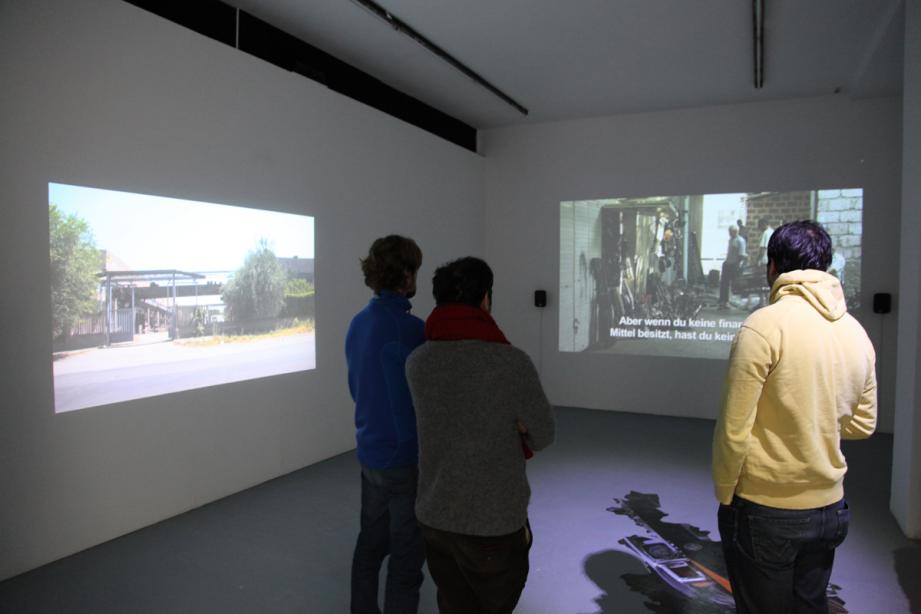
The work ‚In Between’ directs to a more detailed questioning of the role of the beholder. Here, the notion ‚void’ is formulated as a special category, not a formal one. The void is filled out by the audience (the beholder), the admired ‚artwork’ itself is invisible, too. Furthewrmore, the stable surface of the work on the wall moves, but the visitor in front of the piece in the gallery space stands still.
‚In Between’ seems to question how or if the beholder is part of the work, which directs to the question of the social role of art. The way the beholder acts in front of a picture or an art work tells us a lot about the way we think about art and the position we give art in our society, I guess.
In ‚In Between’ the social role of the artwork for an audience becomes clear. It also comes to mind the notion of institutional critique by questioning the function of the exhibition space and the relationship between the artwork and the beholder. Is that an important aspect for you?
SK
Again, it is about replacing an artwork as a symbol of power that we follow recklessly. In this work, I tried to replace an artwork using one of the most important elements to compose artwork, which is viewer. Without viewer art cannot exist. So, I used the viewers as a material to make my work. Art material can be not only object-making.
Two people were watching a same painting, which was in the frame and I replaced the painting to one of the viewers who was watching the painting. Again, because of their special action to artwork, we can be aware of the missing artwork.
FR
To me, ‚Invisible Masterpiece’, and ‚In Between’ seems to question the role of the artwork in society and the role of the institution where it is presented.
Is that correct? How would you define the relation between these to works?
SK
Invisible Masterpiece has more question about institutionalization of artwork whereas In Between has more focus on importance of viewer. Both works reveal importance of viewer’s awareness of themselves to form artwork.
FR
You mentioned the importance of the threefold situation between artist, artwork and the beholder. Could you describe the importance of this connection for you? What is the communicative role of the artwork in your eyes?
SK
As I have mentioned above, realizing relationship between things is important in Buddhism. This method has realistic aspect of finding one’s role in society as well. Human beings are interdependent and have to interact their role with other people in order to survive in society. Interaction means communication. In fact, if we try to penetrate our cultural actions and many other actions in society, the main role of our actions is for communication with others. If we communicate bad there is war and if we do it well there is peace. I believe that visual art is one of the ways of communications through visual language.
Finding the relationship in the threefold is also for better communication with others by reducing the aura of artwork and by breakup art in parts. I think that with this awareness of the importance of this threefold, artist can share his or her work with viewer better because the artist realizes that the artist is not the only one can complete art but the viewer’s active indirect or direct response to the work. Artwork’s main role is to let viewer open their mind in active way.
FR
‘Painter’
Another work I would like to discuss is ‚Painter’. Here, your pressed line drawing animation is used not to describe the movements of the audience in front of the picture, but a man, obviously an amateur painter, copying a ‚masterpiece’ in a museum. Why was it interesting to work on this scene? Was it important for you to reflect a different aspect of the constallation between the artwork and the audience? The social and the cultural position a highly appreciated artwork has, due to its understanding as a masterpiece, is the object to practice the skills of a hobby painter. What was interesting for you to work with this topic?
SK
Again, it is a replacement of masterpiece to emptiness through the painter making a copy of the masterpiece. This painter seems like making a painting continuously with full concentration on it. With this endless action I try to depict the utopian idea of artist’s desire of making masterpiece through an amateur painter.
There is no art without artist as well, so I used this important element as a material to make my work.
FR
‘TV Enlightment’
The window in the front wall of the installtion TV Enlightment which is on display for the fist time here at ‚basis’looks like an abstract picture on a museum wall at a first glance. After approaching the work closely, we can see that the light comes from a TV screen inside the work which we can not see from the front. Inside the white cube, we only perceive the indirect light of commercials with there constantly changing light.
Could you describe the idea about the piece which is clocated between a quotation of other light installations, like Turrell’s, and a rethinking of the role media plays in our society?
SK
Turrell’s pieces have sublime atmosphere because of usage of pure light and well-calculated space with its light in formalistic way. This sublime atmosphere is also one of TV Enlightenment’s aspects but the light source from TV commercials, which has complex composition, makes different approach to its basic idea behind. So, his light is from the pure to the sublime whereas mine is from the complex to the sublime.
In my other works pressed line drawing video, there is always a concrete base of paper for the drawings to hold light. In this TV enlightenment, I try to make a drawing with using only light source on a less base for it.
FR
The installation TV Enlightment was influenced by Marshall McLuhan’s idea of cold and hot media, as you mentioned. As far as I can see, media and its importance for our everyday life and its position for our world experience changed dramatically during the last 40 years since McLuhans text was written. Could you describe the way McLuhans theory is important for this installation?
SK
It creates active response from people to react message from Cool Media whereas hot media leads people’s response to message in passive way in McLuhan’s idea of media. He said that TV was a cool media about 40 years ago. However I think TV is hot media in terms of its immense power to control people’s perception to life now.
I consider TV media as a symbol of power in this work since TV affects our way of thinking so much. By converting massive information from TV into only light, which is the simplest information, I try to change this TV’s aspect of hot media to cool media to open the viewer’s more active way of thinking to the media.
FR
How would you describe the importance of Buddhism for the western art movements I just mentioned and how do you develop your work out of these two traditions, buddhism and Western art theory and history?
SK
I think that Marcel Duchamp’s readymade pieces have an aspect of void since there is no importance of object, but only importance of artist’s intention of making art, which is not physically visible. And this idea has influenced many other art movements, such as Fluxus and conceptual art in 1970s. With this idea of void, Nam Jun Paik and John Cage developed their works further by the idea of Zen-Buddhism. I think that Conceptual Art has also this Buddhism idea in terms of its idea of immateriality.
Buddhism gives me various way of dealing with materials and concept in my works. As I mentioned before the idea of void in Buddhism is not an absolute emptiness, so if I apply this idea to conceptual art then we can see that the original conceptual art went lopsided ideal idea of art. And Greenberg’s materiality has been also to the other way of lopsided idea. The idea of Void is to realize the changing relationship between these two extreme, if I think this idea in art, and between art and life.